Scalar Line Integral
Let be a path of class where and be a continuous function. The scalar line integral of along is defined by
Interpretation. This gives the weighted length of where is the weight.
Vector Line Integral
Let be a path of class where . Let be a continuous function. The vector line integral of along is
Interpretation. If is a vector field of force, then gives the work done on an object when it travels through the vector field along .
Equivalently, if , we can write
Parameterization. Let be a curve in . A parameterization of is a path of class such that the image of is and is injective except at finitely many points.
- closed path: such that
- simple path: no point intersection, i.e., is injective
- closed/simple curve: the parameterization is closed or simple.
Re-parameterization. Let and both be paths of class . We say that is a reparameterization of if there exists a bijective function of class such that and the inverse is of class
- we say is orientation-preserving if
- … orientation-reversing if
Proposition about Integral over Parameterization
If is a re-parameterization of , for function , we have
For vector line integral, the conclusion is similar.
- If it’s orientation-preserving, then
- If it’s orientation-reversing, then
Integral over Curve
Let be a curve and one of its parameterization and define . If has an orientation, we let to preserve this orientation, and define
If is closed or it’s the union of finite number of closed curves, we use
Orientation of Curve
Let be the boundary of a closed and simple region in . We say that is positive oriented if always lies on the left when traversing .
Green’s Theorem
Let be the boundry of a closed and bounded region in . Suppose is the union of finitely many simple closed piecewise curves and is positively oriented. Let be a vector field of class where contains . Then
This conclusion can be expressed in Stokes’ Theorem’s form. If we let , then
so the form is equivalent to
Proof
Proof. We discuss the case when is a type 3 elementary region .
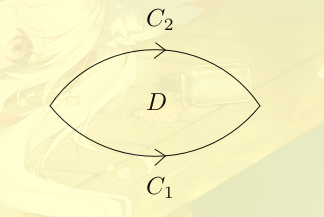
Parameterize orientation-preserving and orientation-reversing .
This shows that
while
Similarly, we can prove that .
Divergence Theorem in
Let be the boundry of a closed and bounded region in . Suppose is the union of finitely many simple closed piecewise curves and is positively oriented. Let be a vector field of class where contains . If is the outward unit normal vector to , then
Proof
Proof. Parameterize as , positively oriented, then its tangent vector is . Thus outward unit normal vector .
So, by definition of , we know